
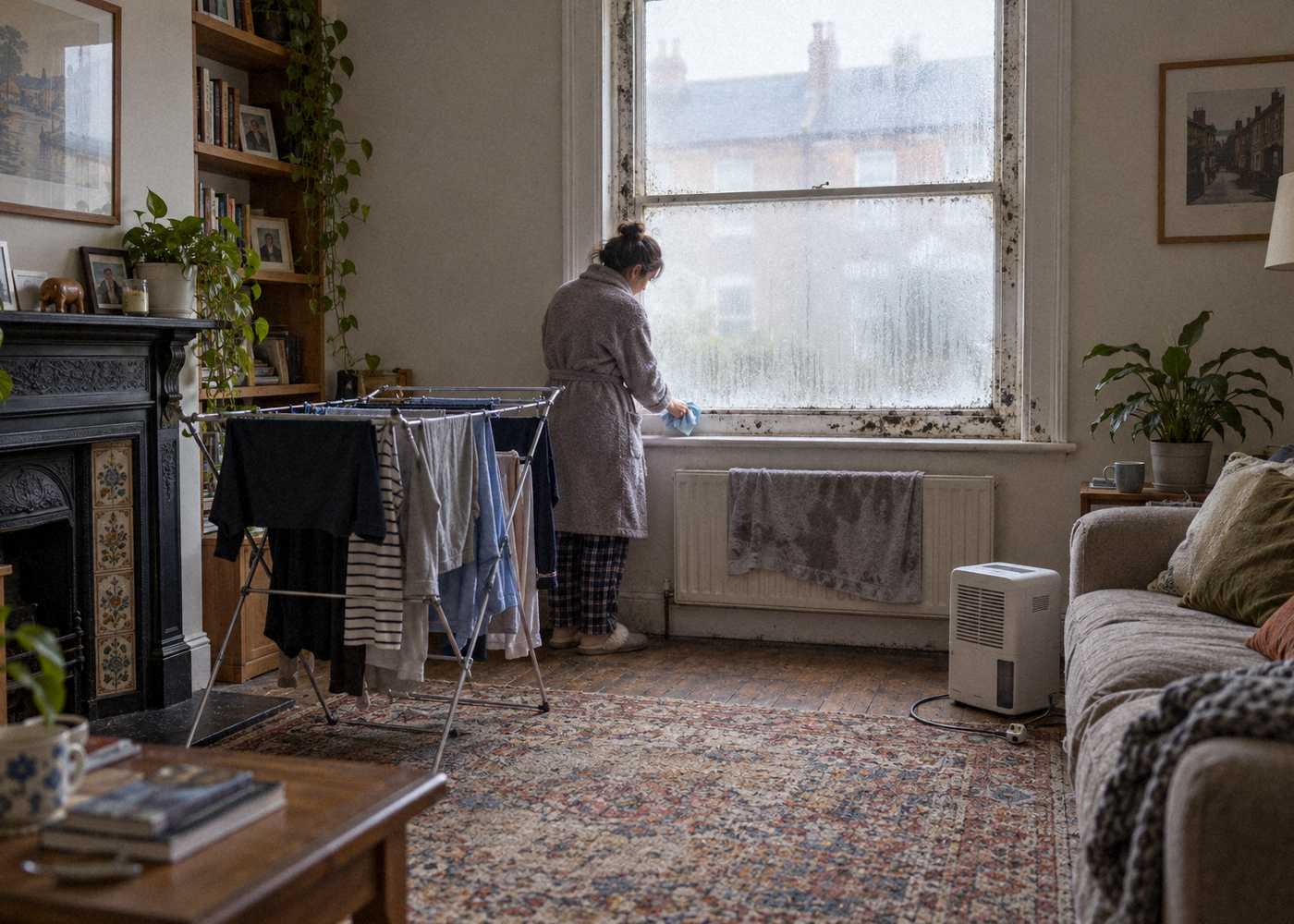
You wake up to wet windows, a dark line of mould along the seal, and a shopping basket holding either a dehumidifier or an air purifier. Which one helps? In the dehumidifier vs air purifier question, the short answer is this: a dehumidifier suits excess moisture in the air, a particle-filtering air purifier suits airborne pollutants, and neither one fixes a leak, a cold surface or mould that is already growing.
So before you buy anything, find out where the water is coming from.
Start by finding where the water is
A dehumidifier only makes sense if the moisture is coming from the room's own air. Work through these steps first.
1. Locate the water. Water on the room-facing glass is ordinary indoor condensation. Water on the outside face is exterior dew, which forms when the glass falls below the outdoor air's dew point and, according to Andersen, usually evaporates during the day. Misting between the panes of a sealed double-glazed unit points to a failed seal, and that needs attention to the glazing, not an appliance.
2. Measure, do not guess. A cheap humidity meter (a hygrometer) shows relative humidity, so you are not relying on how damp the room feels. Note the room temperature and humidity in the morning, midday and evening for a week or so. That shows patterns such as a spike after showers or overnight.
3. Compare your numbers with sensible targets. EPA suggests keeping indoor relative humidity below 60%, ideally between 30% and 50% when possible. In colder climates, ENERGY STAR notes that roughly 30 to 40% may be needed during the heating season to reduce window condensation.
4. Look for water entry and cold corners. EPA lists leaking roofs, leaking or condensing pipes, and gutters or downspouts that send water toward the building as sources to investigate. Cold corners and window frames matter too, because air cooling against a cold surface gains relative humidity until it condenses.
5. Check your extraction. Is the bathroom fan working, and does the kitchen hood vent outdoors? Are the trickle vents on your windows open?
One catch: humidity right beside a cold surface can be higher than the reading in the middle of the room. EPA describes mould problems in rooms reading as low as 30% where cold surfaces dominate. A "normal" number does not clear the window frame.
Dehumidifier vs air purifier: how they compare
These machines do different jobs. A dehumidifier pulls water out of the air and collects it in a tank or sends it down a hose. An air purifier pushes air through a filter to catch particles. Filtering does not remove water, so a purifier on its own will not dry a damp room.
| Dehumidifier | Air purifier | |
|---|---|---|
| Moisture removal | Yes, treats a room or space rather than a whole home | No |
| Airborne particles | Not its job, unless a combination model adds a filter | Yes, if the filter is a proper particle filter |
| Existing mould | Does not remove it | May remove some mould particles from the air, but cannot remove the mould or its moisture cause |
| Maintenance | Empty the tank (the machine usually stops when full) or use a drain hose; clean filters | Clean or replace filters on the maker's schedule |
| Sizing | Match capacity to room size and dampness | Match clean air delivery rate (CADR) to room size |
| Running costs | Depends on watts and hours used | Depends on watts, fan speed and hours used |
Sizing without the marketing gloss
Do not confuse extraction capacity with tank size. As one example, Meaco rates its Arete One 20L at 20 litres per day at 30°C and 80% relative humidity, but its tank holds 4.8 litres. Its published figures also drop to 8.5 litres per day at 20°C and 60%, and 3.4 litres per day at 10°C and 60%. A cool bedroom will not deliver the headline number, so check the rating at conditions close to your own.
For purifiers, EPA gives an example: a 200-square-foot room with an 8-foot ceiling needs a minimum CADR of 130 cubic feet per minute. CADR is usually measured at the highest fan speed, so a quiet setting filters less.
Running costs, with the arithmetic
Cost equals watts divided by 1,000, multiplied by hours, multiplied by your price per kWh. As an illustration only, a constant 200-watt load for eight hours uses 1.6 kWh, which costs £0.48 at an assumed £0.30 per kWh. Real machines cycle on and off, so use your own tariff and a plug-in energy monitor if you can.
What about a combination machine?
A dehumidifier air purifier combination can make sense, but judge it on its parts. Check the actual extraction rate, the filter type and whether the purifier mode runs on its own. In the Meaco manual, for example, a separate air-purification mode does not dehumidify, and the optional H13 HEPA filter needs replacing when it turns from white to grey, roughly every three months depending on conditions. That is one model's schedule, not a rule for all machines.
Which situation calls for what?
| Situation | Most useful first step |
|---|---|
| Persistently humid room, wet glass on the inside | Dehumidifier, plus better ventilation and extraction |
| Normal room humidity, but mould or wetness at isolated cold spots | Warm the surface, improve air movement, insulate; an appliance may add little |
| Misting between the panes | Glazing repair or replacement; neither appliance |
| Dew on the outside of the glass | Usually nothing; it normally clears during the day |
| Leaks (roof, pipes, gutters) | Find and fix the source; renters should report it promptly |
| Indoor laundry drying | Dehumidifier and ventilation, because wet washing raises humidity |
| Separate particle concerns (dust, smoke, pollen) | Air purifier with a proper particle filter |
If you think water is entering from above, our guide to roof maintenance is a useful place to start. One reading or one mould patch cannot tell you which building defect you have, so treat them as clues. If damp is persistent or unexplained, ask for a proper assessment.
Why does mould return after the condensation drops?
Because drier air does not clean anything. Existing mould has to be removed, and EPA warns it will probably come back if the moisture source stays unresolved. An air purifier may catch some mould-related particles and sometimes reduce odours, but EPA is clear that it cannot solve the underlying mould and moisture problem.
For hard surfaces, EPA recommends scrubbing with detergent and water, then drying completely. Porous materials may need to be thrown away, and mould should be removed before any painting or caulking. EPA does not recommend bleach as routine practice, and dead mould still has to be removed. Never mix bleach with ammonia or other cleansers.
Wear at least an N95 respirator, gloves and goggles, as CDC advises. People with mould allergies, a weak immune system, asthma, COPD or other lung disease should not do the cleaning. EPA says householders can usually handle patches under about 10 square feet (roughly 0.93 square metres), but large areas, contaminated water or health concerns call for more help.
After cleaning, good habits keep it from coming back. EPA advises drying materials within 24 to 48 hours after a leak or spill, and drying condensation promptly. Health Canada adds a few simple routines:
- Dry wet window frames and sills daily.
- Open curtains and blinds so warm air reaches the glass, and keep heating outlets clear.
- Run bathroom extraction during bathing and for at least 30 minutes afterwards, vented outdoors.
- Use a kitchen hood that vents outdoors.
- Avoid hanging wet laundry indoors where you can.
Recommendations for your situation
- If your room reads high on the meter and the glass is wet indoors, a dehumidifier is a reasonable aid. Close the windows and doors of that room while it runs, as ENERGY STAR advises, leave space for airflow, and keep normal ventilation in the rest of the home. Do not block vents or seal the room permanently.
- If the dehumidifier collects little water, the cause may be low humidity, a cool room, a humidity target set too high, dirty filters or being in purification-only mode, according to Meaco's troubleshooting guidance. Adjust those before assuming the machine is faulty.
- If you are choosing between more heating and a dehumidifier, the answer depends on the cause. Warming a cold surface and removing moisture both reduce condensation, so use your meter to see which one moves the numbers.
- If the issue is dust, smoke or pollen, choose a purifier sized by CADR, and avoid models that deliberately produce ozone, which irritates the lungs.
Open windows with care, too. Outdoor air only helps when it holds less moisture than the air inside, and EPA cautions that outdoor air during cooling periods can contain as much moisture as indoor air.
If you wish to contribute to our blog, please email us on info@urlmagazine.com.